
Medically reviewed and updated for accuracy by Dr Meg Minasian, MBBS, FRCOphth. (Last reviewed: May 2026)
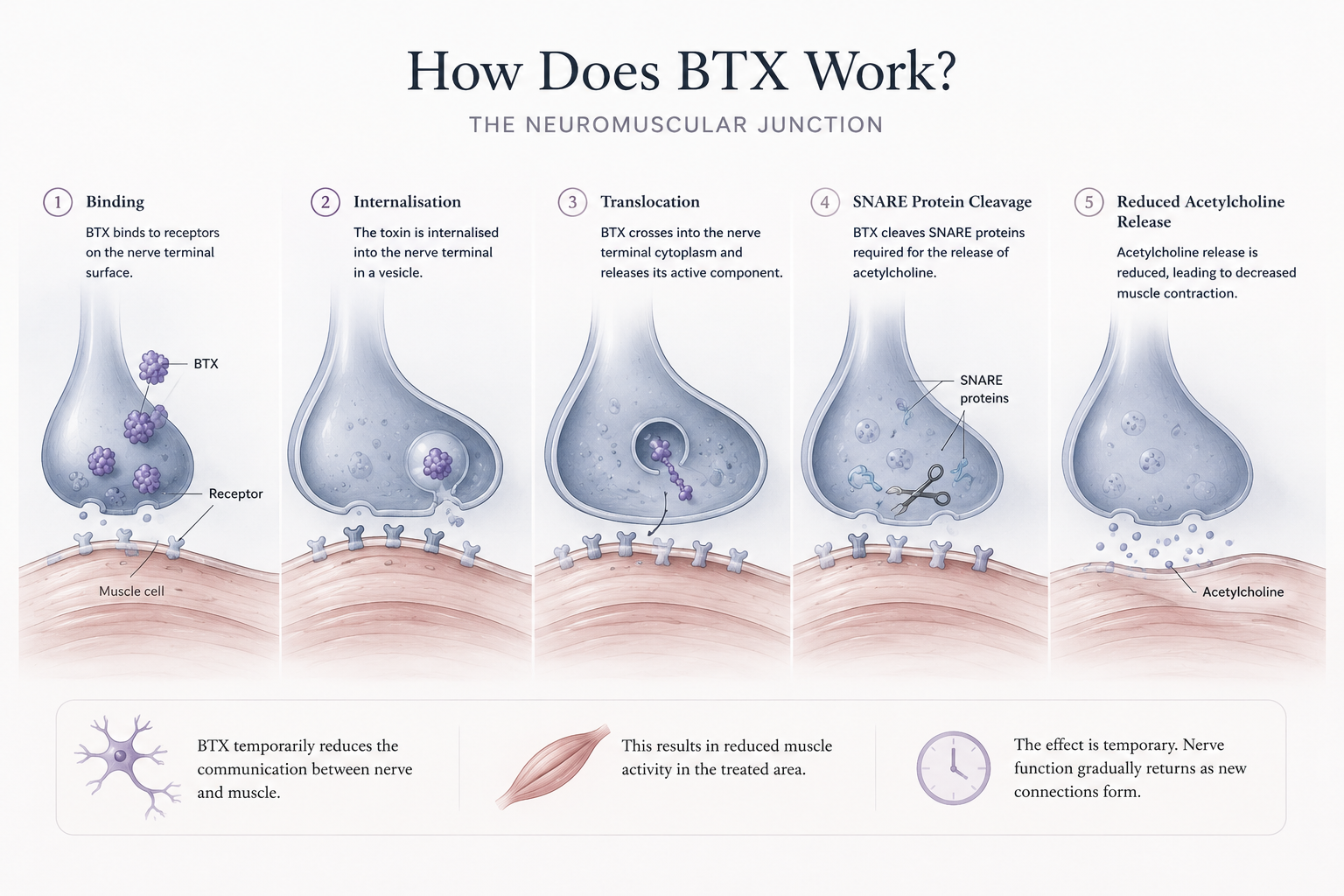
Botulinum toxin works by temporarily interfering with communication between nerves and muscles.
More specifically, it affects the release of a neurotransmitter called acetylcholine, which normally signals muscles to contract.
By reducing this nerve signalling in carefully targeted areas, botulinum toxin can temporarily decrease muscle activity, alter gland function and influence certain neurological pathways.
This mechanism underpins both the medical and aesthetic uses of BTX.
The Neuromuscular Junction
Botulinum toxin primarily acts at the neuromuscular junction, the point where a nerve ending communicates with a muscle fibre.
Under normal conditions:
- nerves release acetylcholine
- acetylcholine binds to receptors
- muscles receive the signal to contract
Botulinum toxin temporarily blocks this process.
As a result, muscle contraction is reduced in the treated area.
Acetylcholine and Nerve Signalling
Acetylcholine is one of the body’s most important neurotransmitters.
It plays a major role in:
- muscle movement
- autonomic nervous system activity
- glandular function
- certain neurological processes
Botulinum toxin works by preventing acetylcholine-containing vesicles from releasing their contents into the neuromuscular junction.
Without sufficient acetylcholine release, muscle activation decreases.
SNARE Proteins and BTX
Botulinum toxin affects proteins involved in neurotransmitter release, commonly referred to as SNARE proteins.
These proteins help nerve cells release acetylcholine effectively.
Different botulinum toxin serotypes target different SNARE proteins.
Botulinum toxin type A, the most commonly used form in medicine and aesthetics, primarily affects SNAP-25.
This prevents efficient neurotransmitter release and temporarily interrupts nerve-to-muscle signalling.
Why The Effects Are Temporary
The effects of BTX are not permanent.
Over time:
- nerve endings gradually recover
- new nerve terminals may develop
- neurotransmitter release resumes
As signalling returns, muscle activity slowly increases again.
The duration of effect varies depending on:
- treatment area
- dose
- product formulation
- muscle strength
- individual biological variation
Many treatments last approximately 3–4 months, although this varies considerably.
Medical Applications of This Mechanism
The ability to temporarily reduce muscle or gland activity explains why botulinum toxin has many therapeutic applications.
Examples include:
- chronic migraine
- blepharospasm
- cervical dystonia
- hyperhidrosis
- muscle spasm disorders
- overactive bladder
- hemifacial spasm
In some conditions, BTX may reduce pain, involuntary movement or excessive gland activity.
Aesthetic Applications of This Mechanism
In aesthetic medicine, BTX is commonly used to reduce dynamic facial lines caused by repeated muscle movement.
By decreasing activity in selected facial muscles, the appearance of lines may soften while natural movement can often still be maintained.
Common aesthetic treatment areas include:
- forehead lines
- frown lines
- crow’s feet
- platysmal bands
- masseter muscles
Does BTX Affect Sensation?
Botulinum toxin primarily affects motor nerve signalling rather than sensory nerves.
However, ongoing research suggests that BTX may also influence:
- pain pathways
- inflammatory mediators
- peripheral nerve signalling
This may partly explain its role in conditions such as chronic migraine and certain pain disorders.
Research in this area continues to evolve.
Why Understanding Mechanism Matters
Understanding how BTX works is important for:
- treatment safety
- appropriate dosing
- anatomical precision
- realistic expectations
- complication management
The mechanism of action also helps explain:
- why treatments wear off
- why side effects may occur
- why different products behave differently
- how resistance may develop
Frequently Asked Questions
Does BTX permanently stop muscles working?
No. The effects are temporary and gradually wear off over time.
What neurotransmitter does BTX affect?
Botulinum toxin primarily affects acetylcholine release.
Does BTX destroy nerves?
No. BTX temporarily alters nerve signalling but does not permanently destroy nerves when appropriately used.
Why does BTX wear off?
Nerve endings gradually recover and resume neurotransmitter release over time.
Does BTX only affect muscles?
No. BTX may also influence glandular activity and certain neurological pathways.
Related Articles
- What Are SNARE Proteins?
- BTX and Facial Anatomy Explained
- Can BTX Cause Muscle Atrophy?
- Diffusion vs Migration in BTX Treatment
- BTX and Blinking Explained
- BTX Resistance Explained
Further Reading & References
- Simpson LL. The origin, structure and pharmacological activity of botulinum toxin. Pharmacological Reviews. 1981.
- Rossetto O, Pirazzini M, Montecucco C. Botulinum neurotoxins: genetic, structural and mechanistic insights. Nature Reviews Microbiology. 2014.
- Dressler D, Saberi FA, Barbosa ER. Botulinum toxin: mechanisms of action. Arquivos de Neuro-Psiquiatria. 2005.
- NIH and PubMed educational resources relating to botulinum toxin mechanism and neuromuscular signalling.
Medical Disclaimer
The information provided on BTXExpert is intended for educational purposes only and should not be considered medical advice. Individuals should seek personalised advice from an appropriately qualified healthcare professional regarding diagnosis, treatment suitability, risks and alternatives.