
Medically reviewed and updated for accuracy by Dr Meg Minasian, MBBS, FRCOphth. (Last reviewed: May 2026)
Facial anatomy plays a central role in both the safety and effectiveness of botulinum toxin treatment.
BTX works by temporarily influencing communication between nerves and muscles. Because facial muscles are closely interconnected and highly specialised, even small differences in anatomy or injection placement may influence movement, expression and treatment outcome.
Understanding facial anatomy is therefore important in both medical and aesthetic applications of BTX.
Why Facial Muscles Are Different
Facial muscles differ from many other muscles in the body because they are closely linked to:
- facial expression
- eye protection
- speech
- eating
- emotional communication
- and social interaction.
Many facial muscles also insert directly into the skin rather than into bone.
This contributes to the complex and highly dynamic nature of facial movement.
Facial Expression and Muscle Balance
Facial movement depends on balance between multiple muscle groups working together.
Examples include:
- forehead elevation and brow depressors
- eye closure and eyelid support
- smiling muscles and lower facial stabilisers
- neck muscles and jaw balance
Changes in one muscle group may therefore influence neighbouring regions.
This interconnected anatomy is one reason why treatment outcomes vary between individuals.
Common Muscles Discussed in BTX Treatment
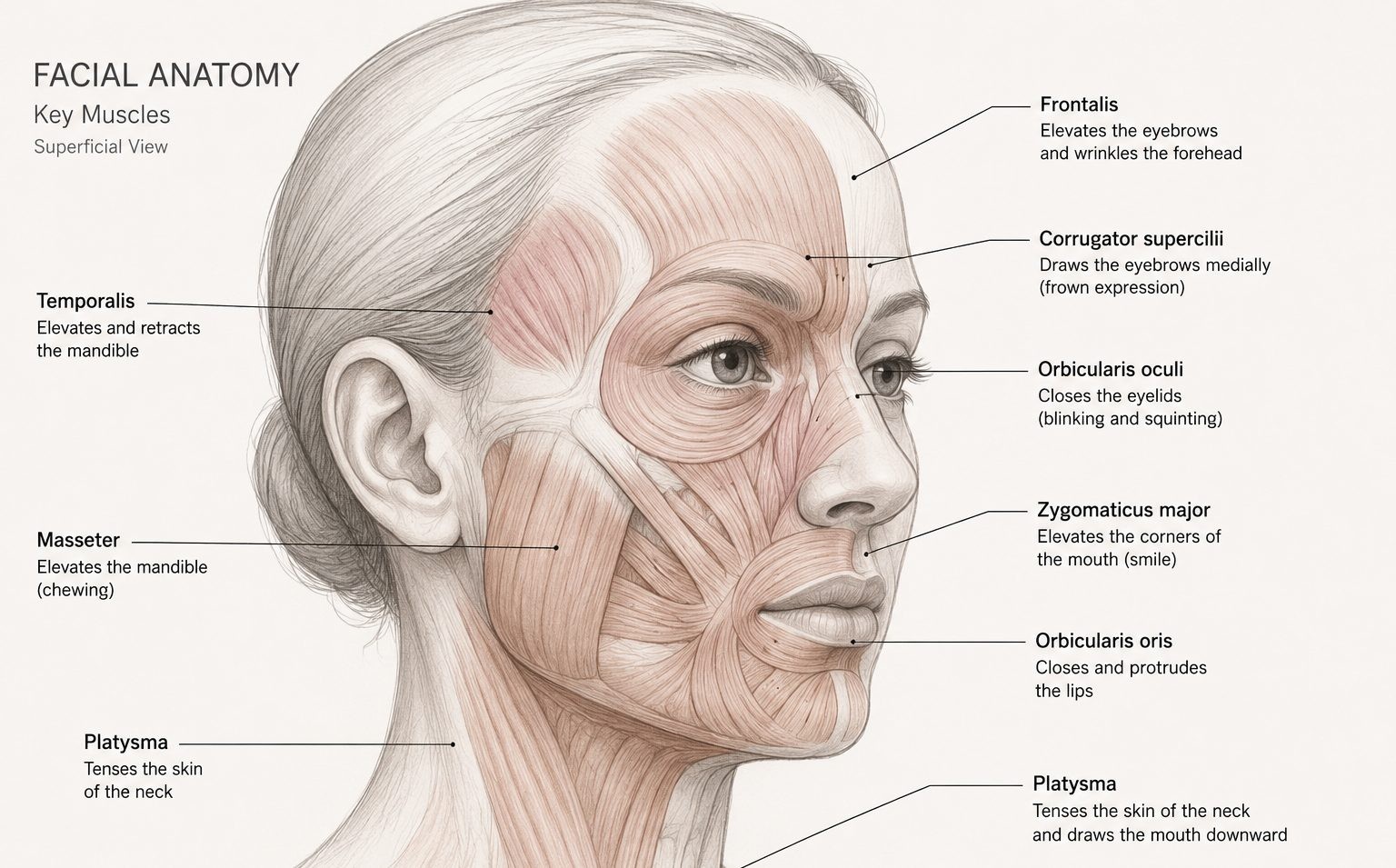
Muscles commonly involved in aesthetic BTX treatment may include:
- frontalis
- corrugator supercilii
- procerus
- orbicularis oculi
- masseter
- platysma
- mentalis
Each muscle has different:
- movement patterns
- anatomical relationships
- depth
- strength
- and functional importance.
Why The Periocular Region Is Complex
The periocular region around the eyes contains highly specialised muscles involved in:
- blinking
- eyelid support
- tear film maintenance
- brow balance
- and eye protection.
Small changes in muscle balance may influence:
- eyelid position
- brow shape
- blinking dynamics
- dry eye symptoms
- and facial symmetry.
This is one reason why periocular anatomy requires careful understanding in BTX treatment.
Dynamic vs Static Facial Lines
Facial lines are often discussed as:
- dynamic lines
- or static lines.
Dynamic lines appear primarily during movement.
Static lines remain visible at rest and may reflect:
- long-term muscle activity
- skin ageing
- collagen changes
- sun exposure
- and skin quality factors.
Understanding the relationship between movement and skin structure is important in treatment planning.
Why Anatomy Influences Safety
Many recognised BTX complications relate partly to anatomy and toxin spread.
Examples include:
- eyelid ptosis
- brow asymmetry
- altered smile dynamics
- dry eye symptoms
- unwanted muscle weakness
Careful anatomical assessment may help reduce risk, although no treatment can eliminate risk entirely.
Facial Ageing and Anatomy
Facial ageing involves much more than muscle movement alone.
Changes may occur involving:
- skin thickness
- collagen
- fat compartments
- ligament support
- bone structure
- hydration
- and muscle behaviour over time.
Modern treatment approaches increasingly consider the broader relationship between facial anatomy and ageing processes.
Why This Topic Matters
Public discussion surrounding BTX often focuses heavily on visible cosmetic outcomes while underestimating the importance of anatomy and function.
In reality, successful treatment planning requires consideration of:
- facial dynamics
- muscular balance
- movement preservation
- functional anatomy
- and individual variation.
Anatomical understanding remains one of the most important foundations of evidence-based BTX treatment.
Related Articles
– BTX Around The Eyes Explained
– Can BTX Cause Muscle Atrophy?
– Preventative BTX Explained
– BTX and Blinking Explained
– Diffusion vs Migration in BTX Treatment
Frequently Asked Questions
Why is facial anatomy important in BTX treatment?
BTX affects nerve-to-muscle signalling, so anatomy strongly influences both outcome and safety.
Do all faces move in the same way?
No. Muscle activity and facial dynamics vary considerably between individuals.
Why is the eye area more complex?
The periocular region contains specialised muscles involved in blinking, eyelid support and eye protection.
Can anatomy influence side effects?
Yes. Anatomical variation may influence treatment effect and complication risk.
Is facial ageing only caused by muscle movement?
No. Facial ageing involves multiple structural and biological processes.
Medical Disclaimer
The information provided on BTXExpert is intended for educational purposes only and should not be considered medical advice. Individuals should seek personalised advice from an appropriately qualified healthcare professional regarding diagnosis, treatment suitability, risks and alternatives.